


Seven years. That’s how long I spent doing almost everything the self-improvement world told me to do.
I created vision boards. I visualized my dream life. I repeated affirmations. I meditated. I tried to think positively.
Sure, some of it worked. I experienced a handful of wins: unexpected gifts, new friendships, even going viral on social media.
I’m grateful for every one of those experiences. But I wasn’t making any real change in my finances, relationships, or health. Like a car stuck in the mud, no matter how hard I pressed the gas, I never seemed to move forward. At some point, I simply took my foot off the gas and stayed stuck in the mud, not making any effort to change.
Until this summer, when a painful moment woke me up to where this path in my life would lead if I didn’t change (more on that story in a minute).
This is when I had one of those “ah-ha” moments. Instead of focusing more on what I wanted, I had to wake up to the cost of staying the same.
You see, I had learned this lesson before. It’s how I was able to overcome a drinking problem and stay sober for more than seven years. The cost of staying the same had become too high, and I finally made a lasting change.
Before we go further, I want to be clear: this isn’t an argument against vision boards, affirmations, or visualization. They can be powerful tools.
It’s an exploration of a different approach to change: what happens when you stop asking, “What do I want?” and start asking, “What is it costing me to stay exactly as I am?”
Why knowing what you want isn’t always enough
Spend any amount of time in the personal development world and you’ll hear the same advice regurgitated over and over: Decide what you want, set goals, work hard, and stay positive.
And sure, on paper it sounds fine. But the problem is that almost everyone already knows what they want. They want more money, to meet their soulmate, 100k+ subscribers on Substack, more freedom, etc.
They’ve daydreamed about it in the shower a thousand times.
So why don’t they change? Why do we continue repeating the same patterns, even when we know exactly what we want?
Because for many of us, wanting something isn’t enough. Change happens when we wake up, look at ourselves in the mirror, and say: I cannot keep living this way.
That moment looks different for everyone.
For my dad, it was quitting smoking cold turkey after having a stroke.
For my 27-year-old self, it was finally getting sober after one hangover too many.
For a friend of mine, it was leaving a soul-sucking job after realizing she couldn’t bear another year of Sunday-night dread.
The common thread here? They finally saw the cost of staying the same.
The goal isn’t to become dissatisfied with your life. It’s to recognize that every choice (including the choice not to change) comes with a price.
I believe that’s when people stumble upon what Napoleon Hill called a burning desire.
There’s a good chance you’ve read Think and Grow Rich, but in case you haven’t, Hill wrote that desire is the starting point of all achievement.
I agree, but I don’t think a burning desire appears out of thin air. It is born when you can no longer ignore what your current path is costing you.
For me, this shift has been far more motivating than any vision board or affirmation ever was.
The cost I could no longer ignore
I’ve been dreaming of making more money for years now. My main issue is constantly switching directions.
After leaving my pharmacist career, I was a ghostwriter for about 5 years, then I did freelance interior design work for a local company for nearly 4 years. In between all of that I’ve tried blogging, coaching, content creation, reselling things on Marketplace and Ebay, creating digital products, selling my artwork, etc.
Some ideas worked better than others. Yet, I didn’t really stick with anything long enough for it to gain traction. Which explains why I’ve been just barely getting by financially for a long time.
This entire time I’ve been imagining what it would look like to be in a better place financially: summers visiting family up north, vacations with my son, or even just going out to a restaurant without having to stress about the bill.
But those dreams of a better future were just that: dreams. Imagining a better life wasn’t enough for me to consistently change my behavior. Reflecting on these years, I think subconsciously I was believing “Things will probably work out eventually.”
Then, everything changed this summer.
My son finished kindergarten in May and was home with me for the summer. The summer started off ideal in many ways—sunny days spent at the pool, cookouts with friends, and he even taught me how to play chess (yes, my 6-year-old taught me how to play chess).
As the weeks went on, though, I noticed I kept having to tell him no to some of the more exciting things he wanted to do… an extra trip to visit my parents, a day at the amusement park, going out to a restaurant, all experiences I would have loved to give him.
Seeing how disappointed he was hurt. It hurt a lot. And I think it’s because of what that disappointment represented.
It was the painful realization that I wasn’t living up to my potential. That I had spent years dreaming about creating a better life, yet I was still in the same place, just making ends meet.
I imagined what it would feel like if I was in the same exact place next summer, and that image was the turning point. I decided the cost of staying the same had become too high.
How to use this approach (without waiting for rock bottom)
Just to be clear, calculating the cost of staying the same is not about hating your life, it’s not about only imagining the worst case scenario, and it’s not about waiting until you hit rock bottom.
It’s about intentionally looking ahead and asking, “If nothing changes, where will this path lead?”
If you like where the path leads, keep going. If you don’t, it’s time to make identity-level changes that align your daily actions with the person you want to become. Here’s how:
1. Make the cost of staying the same visible
Okay, you’ve probably already imagined the future you want, but how about the future you’ll get if nothing changes?
Journal on these questions:
If I keep making today’s choices, where will I be one year from now? Five years? Ten years?
Who else is affected if I don’t change?
What opportunities do I miss out on if I keep living this way?
How will I feel if next year looks exactly like this year?
When I was researching this topic, I came across the term “decisional balance”.
In psychology, the concept of decisional balance suggests that before making a change, we weigh the perceived benefits and costs of both options: changing and staying the same.
The process can be mapped out into four quadrants, which would look something like this:
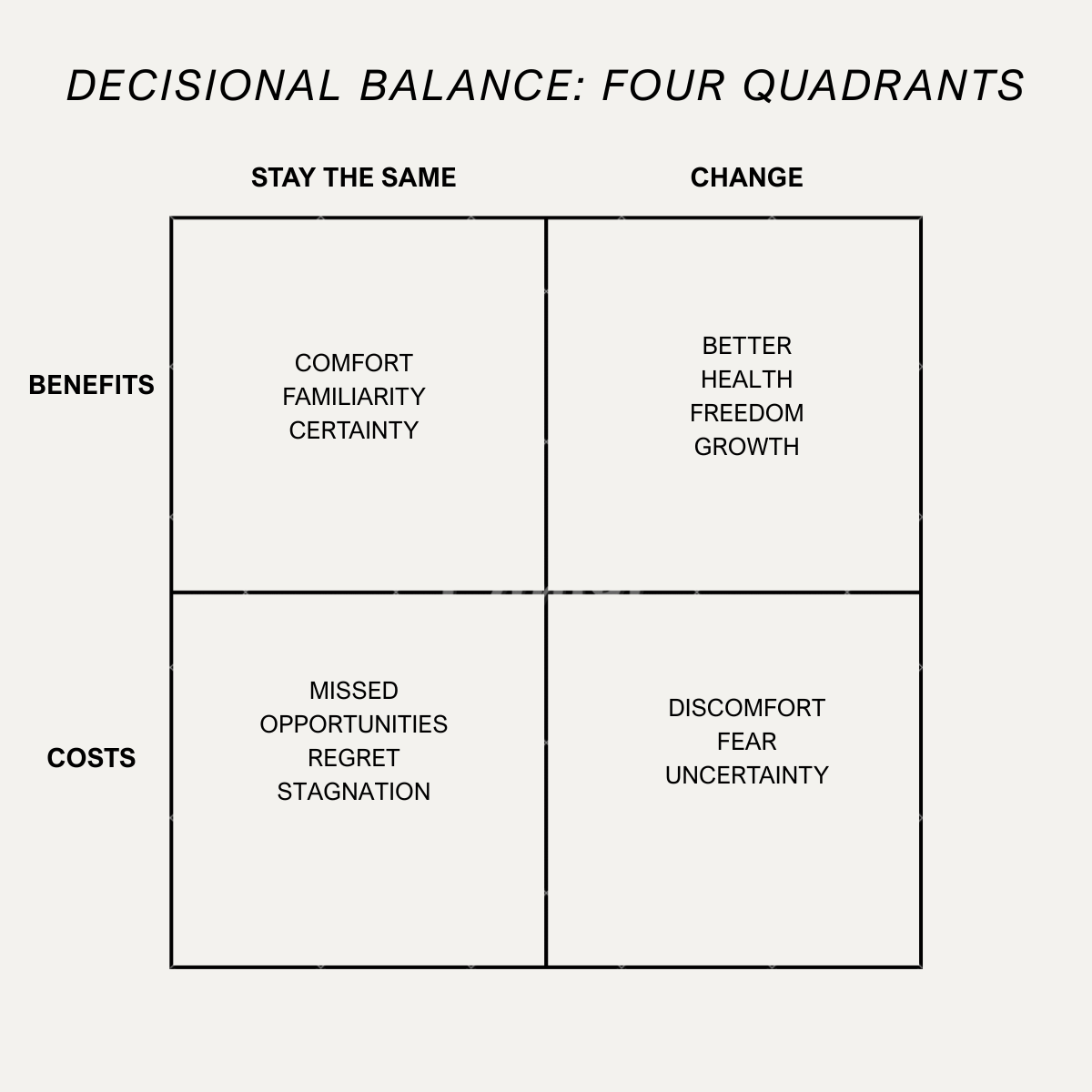
There are four questions we’re answering, whether we realize it or not:
What are the benefits of changing?
What are the costs of changing?
What are the benefits of staying the same?
What are the costs of staying the same?
Most of us spend nearly all of our time thinking about the first three.
We imagine the life we’ll have if we change. We worry about how uncomfortable change will be. We remind ourselves of the comfort and certainty that come from staying exactly where we are.
But we rarely stop to ask the fourth question: What is staying the same actually costing me?
Not just financially, but also in experiences, relationships, confidence, and in the person you never become.
For example:
If you never share your writing, the people who need your ideas may never find them.
If you never prioritize your health, you may never have the energy to play with your children or grandchildren, or enjoy the life you’re working so hard to build.
If you never tell someone how you feel, you’ll never know whether they could have become one of the most important people in your life.
Personally, I think it would be such a tragedy to wake up 30 years from now and think about the version of myself I could have been if I had just done the hard things.
But, like I mentioned earlier, the goal isn’t about catastrophizing, hating your life, or scaring yourself into action.
The goal is to use this realization as the catalyst for change. Use it to create a burning desire to finally become the person you know you’re meant to be.
2. Change who you are, not just what you do
Seeing the cost of staying the same can create the motivation to change. But motivation alone isn’t enough. The version of yourself that created your current life can't create your future one.
So answer this question: Who is the person who already has the life you want?
Not what do they own.
Not what car they drive.
Who are they?
How do they think?
How do they start their mornings?
How do they spend an hour that everyone else wastes?
How do they respond when they don’t feel motivated?
Journal the answers to these questions.
For years, if you’d asked me what I wanted, I could have given you a long list: making money doing what I love, creating something meaningful, and ultimately having more time to do what I want to do.
But if you’d asked me who I was becoming, I wouldn’t have had an answer.
As I mentioned earlier, I pursued a lot of different paths over the years, but what kept resurfacing was writing.
I started my first blog in 2017, but I abandoned it because of self-doubt, inconsistency, and not knowing how to turn it into a viable business. Now, almost a decade later, I sometimes wonder where that blog would be if I had just kept going?
That question became part of the cost of staying the same. Add to that my realization this summer of how deeply it hurt to feel like I was disappointing my son, and I knew it was time to return to writing.
Today, my focus isn’t only on making more money (outcome). My focus is on becoming a writer (identity).
Writers write.
They write daily.
They write when no one is reading.
They improve their craft.
They write even when they’re tired or unmotivated because that’s who they are.
Once you decide who you want to be, you let your identity guide your daily decisions.
You’ll stop asking, “What should I do today?”
And instead ask, “What would the person I’m becoming do?”
Then you do that. Again. And again. Until one day, the life you once imagined no longer feels like a distant dream. It feels inevitable. It’s the natural outcome of the person you’ve chosen to become.
x,
K
P.S. This newsletter exists because I believe it’s never too late to begin again. If you’re questioning your path, craving change, or trying to become someone new, I’d love to have you here :)
Oh my goodness…. I guess I call you K? Oh my goodness K. This was so, so, so good.
I appreciate the vulnerability, the grounding and the challenge this essay brings to the forefront.
So good. I know… I already said that. lol
I think my essay on growth will complement this essay nicely.
As you were going through the change decision quadrant — funny thing is, this is part of what I do professionally.
I am a certified Change Management Consultant, amongst other certifications and things I do (process improvement is my favorite though). In my work we use the ADKAR model, and the six essential questions:
What is changing?
Why is it changing?
What is not changing?
Why is it changing now?
What are the benefits of changing?
What are the risks of not changing?
Also… congratulations on your sobriety. That, is a tremendous accomplishment and with every day of winning that battle, you are Becoming Again. Never forget what you are giving yourself, your son and the others around you with that victory (I drank a lot when I was younger too. By the grace of God that I didn’t get myself or someone else killed. And thankful I was able to put the bottle down before anything serious found me).
Ohh.. so much more I could/would say… but I’m already running long and rambling. So I’ll stop here.
But wow, K. This was great.
Thanks for mentioning it so I could come read it.
What a great way to start my Friday.
I really appreciated the honesty here, especially after so many years of doing all the “right” self-improvement things.
It makes me think about how change sometimes starts before we consciously decide to change. A strange dream, an unusually strong reaction, a recurring conflict — something begins disturbing the old arrangement.
In dreamwork I’m often less interested in fixing that disturbance than in asking what new way of being might already be trying to appear through it.