


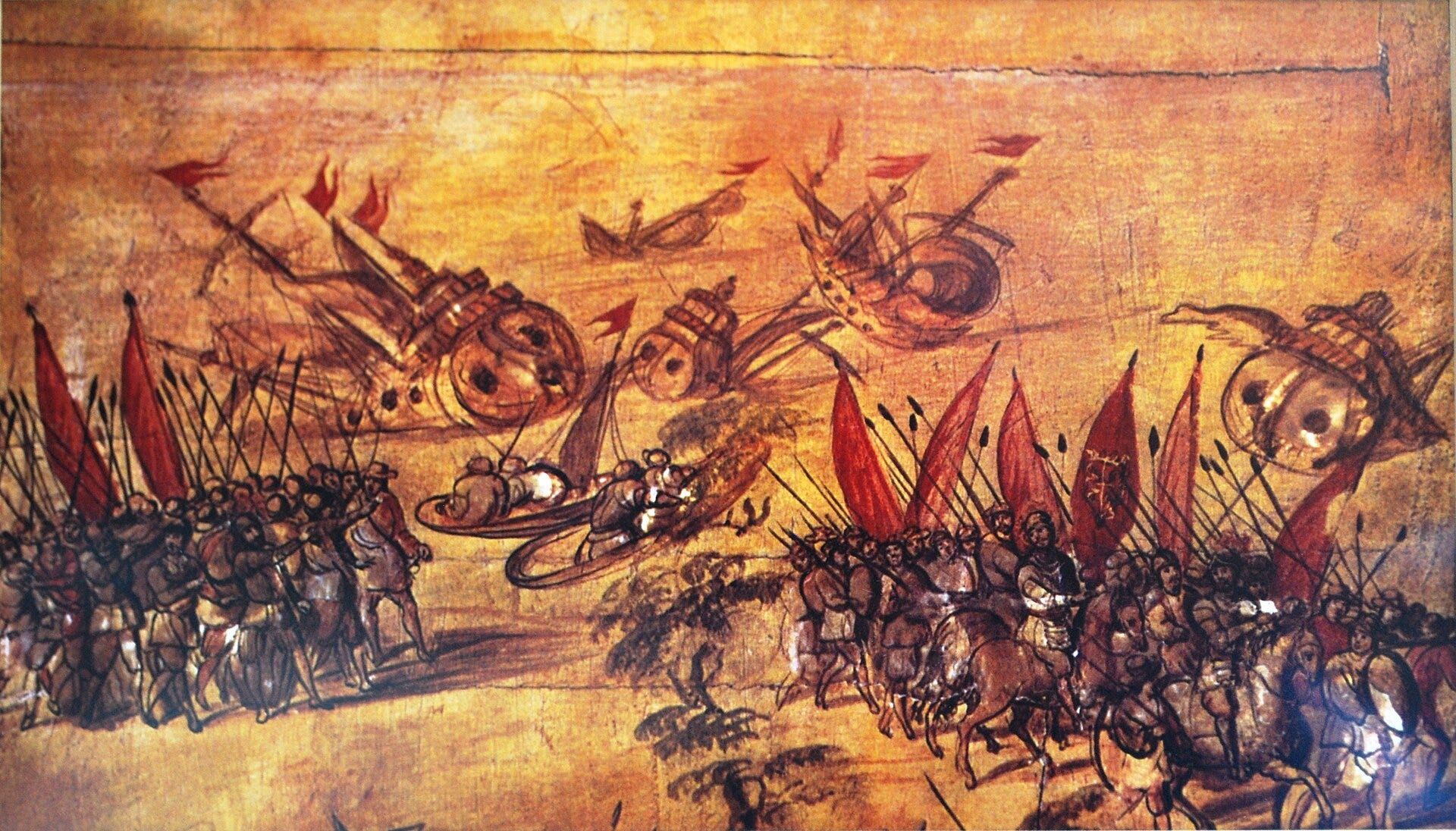
There’s a famous story about a Spanish conquistador named Hernán Cortés who, apparently, ordered his men to burn their ships after arriving in Mexico in 1519.
The reason? He was about to lead his men into unfamiliar territory to face an enemy they knew very little about, and he realized they had an easy way out. Their ships were waiting on the shore.
According to the story, Cortés ordered his men to burn the ships.
Upon doing a little digging, I learned that they probably didn’t actually burn them. They most likely scuttled them. If you’re like me and aren’t familiar with the word, it means to deliberately sink a ship.
So, the ships weren’t actually burned, yet the phrase “burn the ships” has lived on in the personal development world. And I love the metaphor, so we’re using it.
Essentially, to “burn the ships” is to eliminate the possibility of going back.
For Cortés and his crew, that decision completely changed the choice they faced each morning. They weren’t deciding whether to continue or turn around. Turning around was no longer an option.
This idea has lived on for centuries because there’s something powerful about eliminating the option to go back.
I believe it’s what real transformation requires.
When starting any type of transformation, we often think we need more motivation or willpower. And sure, motivation and willpower can help us get started. But I believe lasting change comes from making a decision so complete that our old self becomes impossible.
Leave the door open to your old self? You’ll keep having to choose between who you were and who you want to become.
Close the door on your old self? There’s no more asking, “What should I do?” Instead, you ask, “What would the person I’m becoming do?”
So how do you actually close that door? How do you use your identity to change the choices you make every day? Let’s talk about it.
The first time I burned the ships
I’ve been sober for over 7 years, and what I learned most from this experience is the power of identity level change.
You can read the full story here, but to summarize the main idea: I always identified as a drinker, so every time I tried to quit drinking (the behavior), I eventually went back because there was still a choice.
I was a drinker, and I had a choice for my behavior: drink or not drink.
That made things incredibly difficult because the option to drink was still there.
When friends around me were drinking, I would try to choose not to drink. But more often than not, I gave in to the temptation.
Then, I hit my rock bottom moment, which led me to finally decide: this is not who I am anymore. I’m not someone who drinks. I’m 100% sober.
I went from saying, “I’m not drinking,” to saying, “I’m not someone who drinks.”
Doesn’t seem like a big difference, right? Well, this identity shift completely changed the way I approached each day. I went from trying to change my behavior to changing my identity. By doing so, I eliminated the choice to be someone who drinks. Instead of negotiating with myself every time alcohol was an option, the decision had already been made. I had burned the ships.
Do your beliefs match your new identity?
To make your old self impossible, you have to leave behind the beliefs tied to that old identity. Leave them on the ship!
When I was struggling with alcohol, one of the biggest things keeping me from quitting was that my beliefs still belonged to someone who drinks.
I believed alcohol relieved my stress. I also believed that since I didn’t drink every day, it wasn’t really affecting my health. And let’s not forget drinking culture: I believed that if I wanted a social life, I had to drink too.
Then I read This Naked Mind by Annie Grace (this book saved my life) and one by one those beliefs began to fall apart.
I learned that alcohol wasn’t relieving my stress at all. It was, in fact, making it worse. I realized that no amount of alcohol is actually safe for the body. And just because drinking culture is the norm doesn’t mean I have to participate.
The book challenged dozens of beliefs I had accepted as facts. Once the old beliefs began to fall away, it felt so much easier to get sober. I wasn’t constantly fighting the urge to drink because I no longer believed I was giving something up. My new beliefs supported my new identity!
The same principle applies to every area of life.
If you want to become a writer but you believe, “I’ll never make money writing,” you’re going to give up 6 months into your writing journey.
Or maybe you want to become a runner but you believe, “I suck at cardio”, the identity you’re trying to create and your current beliefs contradict each other.
How to get your beliefs to support your identity? Journal on this:
Imagine the person you want to become. What beliefs does he or she have about money, relationships, success, health, life, etc.?
Which of your current beliefs contradict that identity?
Which beliefs do you need to let go of because they belong to your old self?
How to become the person you want to be using identity level change
Who do you want to be? A business owner? A writer? An artist? Someone who consistently goes to the gym? Someone who eats healthy?
Decide who you want to be, then let that identity filter your choices. Let’s use the eating healthier example because I bet that’s one we can all relate to.
Imagine this: The day has been long as f*ck. Work issues, traffic, kid throwing a tantrum because you opened the string cheese instead of letting him open it himself (been there).
Whatever it is, the day has been rough.
You suddenly remember that bag of chips in the pantry. Salty, crunchy chips would be sooo satisfying after the day you’ve had.
But you remind yourself there’s also a fridge full of fresh fruit, vegetables, and an entire shelf full of the good stuff you picked up at Whole Foods when you vowed to eat healthier.
The old version of you might negotiate with themselves: “It’s been a rough day, just this one time won’t hurt.”
But someone who identifies as a healthy person doesn’t have to negotiate with themselves every evening.
They remind themselves: “I take care of my body. I don’t eat junk food just because I had a bad day.” And then they choose a healthier option.
The choice becomes much simpler because it has already been filtered through their identity.
They’ve “burned the ships” on the old way of living. The option to regularly eat junk food isn’t part of the identity they’ve chosen anymore.
They don’t have to keep deciding who they’re going to be. They’ve already decided.
Design your environment so your desired identity wins by default
We’ve talked about how your identity should filter your decisions. It’s simple, but not easy. You can make it a little easier by designing your environment strategically. Let me explain with the example of chips vs. healthy foods:
When you first decide to start eating healthier, your brain has to strengthen new neural pathways to support the healthier choices.
But we cannot forget that the old pathways are still there.
The pathway that says, “I’ve had a long day. I deserve some chips,” has been reinforced hundreds (maybe thousands) of times. It’s this repetition that strengthens neural pathways. This is known as neuroplasticity (your brain’s ability to change and form new neural connections at any point in your life).
Essentially, that means your response (in this case, eating the chips) feels almost automatic.
Your new pathway hasn’t had enough repetitions yet to compete. That’s why, in the beginning, we can make it a bit easier by designing your environment to support your new identity.
So… don’t buy the chips in the first place. Or if you’re like me, don’t buy the coconut roll cookies from Aldi. They’re so good, but I can eat the whole bag in one sitting (and I do, if they are in the house that is). Chang your environment by filling your pantry and refrigerator with foods that align with the person you’re becoming.
By removing the temptation from your environment, you give your new neural pathways time to strengthen until the healthier choice becomes the automatic one.
Other examples:
You want to become a more focused person?
Delete the apps that are stealing your attention. Log out of Youtube, Netflix, Hulu, etc. Put your phone in another room while you work. Make focus the easiest option.
You want to become a writer?
Create a dedicated space for writing at your home (even if it’s at the kitchen table, like me). Carry a pocket notebook with you. Create a folder in your Notes app that you can quickly add ideas to when they come to you. Make writing easier than mindlessly scrolling.
Decide once
Cortés didn’t go back and forth every day trying to decide whether or not his crew should fight or retreat. He decided once that they would fight (and made retreat basically impossible by scuttling the ships).
I think so many people stay stuck in their current identity (even though they consciously want to change) because they keep making the same decisions over and over, day after day.
Should I write today?
Should I go to the gym?
Should I eat healthy?
When you make the behavior optional by asking these questions, you’re giving your old self the chance to win.
Would a writer ask if they should write today? No.
Would a person who has built their dream physique ask if they should go to the gym? No.
Would a healthy person ask if they should eat healthy food? No.
The person you want to become has already made those decisions.
They decided once.
I’m not saying you’ll never feel tempted or have difficult days. But when you have those moments, you must remind yourself of your new identity. Stop renegotiating who you are.
Make the old self impossible by deciding who you are once. Then allow that identity to guide every decision that follows.
x,
K
P.S. This newsletter exists because I believe it’s never too late to begin again. If you’re questioning your path, craving change, or trying to become someone new, I’d love to have you here :)